Unfair Flips - A Game About Probability
Unfair Flips is a game where you flip a coin. You have to flip it so that it lands on heads ten times in a row. The coin flip starts out "unfair" and as you gain money from flipping heads, you're able to purchase upgrades that make the coin flip progressively more fair/unfair in the opposite direction. You can buy it on Steam for 2 dollars.
I think it might be one of the best games ever created.
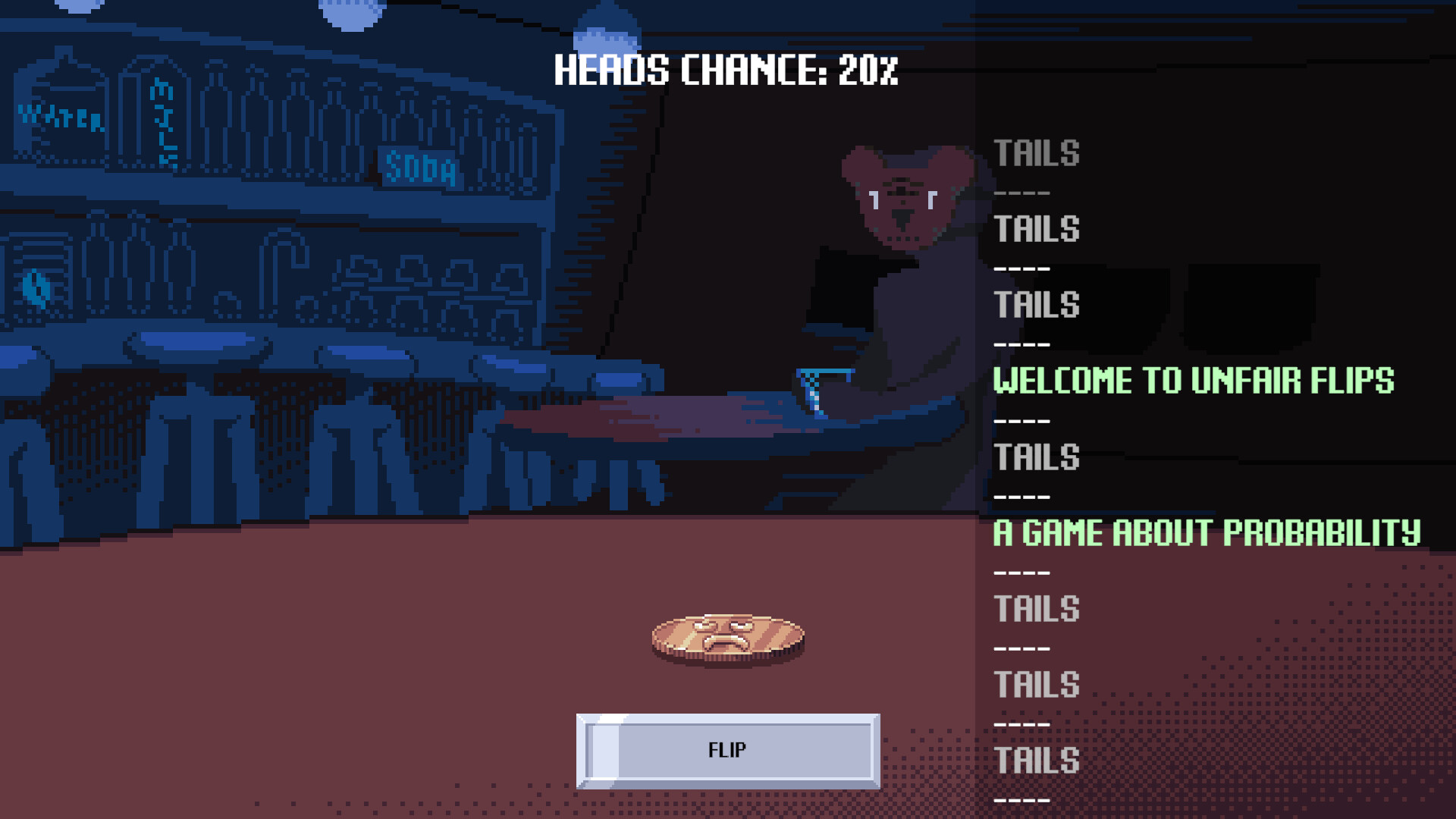 (Image credit Heather Flowers/Steam)
See, Unfair Flips is, moreso than anything else, a meditation on the nature of probability and the superstitious nature of humans. The "gimmick" of this game is that the game is honest about the probabilities, and everything is purely down to luck and randomness. You could get lucky and win 10 heads right away (statistically improbable) or get unlucky and never get 10 heads ever (also statistically improbable). But it could happen, theoretically. It is in a sense, kind of a rage bait game, you'll no doubt find yourself in a chain of 7, 8, 9 heads in a row and then lose the next coin flip when it "feels" like it shouldn't.
Going in, I thought I was wise to this game's tricks, I thought I understood that the odds are the odds and that I would never get baited by the game. But inevitably, when playing, you'll start to have little thoughts like "what if I click 'flip' exactly when the coin lands? Maybe that'll make it land on heads better", and then when that doesn't work, you'll start to think "maybe I was clicking it too soon and I need to wait longer between each flip". Maybe if you purchase an upgrade during a streak, that'll ruin your streak, so you wait until you lose the streak to purchase the upgrade even though getting it earlier is technically better. This is all, of course, nonsense, and you'll probably be fully aware of it's nonsense as you're doing it. But it is in the nature of humans to be superstitious like this, so you do it anyway.
Once you get to the 10th flip after 9 flips in a row, the game pulls a dirty trick. Assuming you land the 10th flip, you then actually only have a 10% chance of the coin landing as heads and you "winning" the game, with several other endings that can happen instead, such as the coin landing on it's side, or exploding, or turning into an Eggbug. At the time of this writing, I still haven't achieved the mythical 10th flip. The first time I played through the game, I got the Land The Coin On It's Side (20% Chance) ending. I wanted to see some of the other endings, so I started the game again.
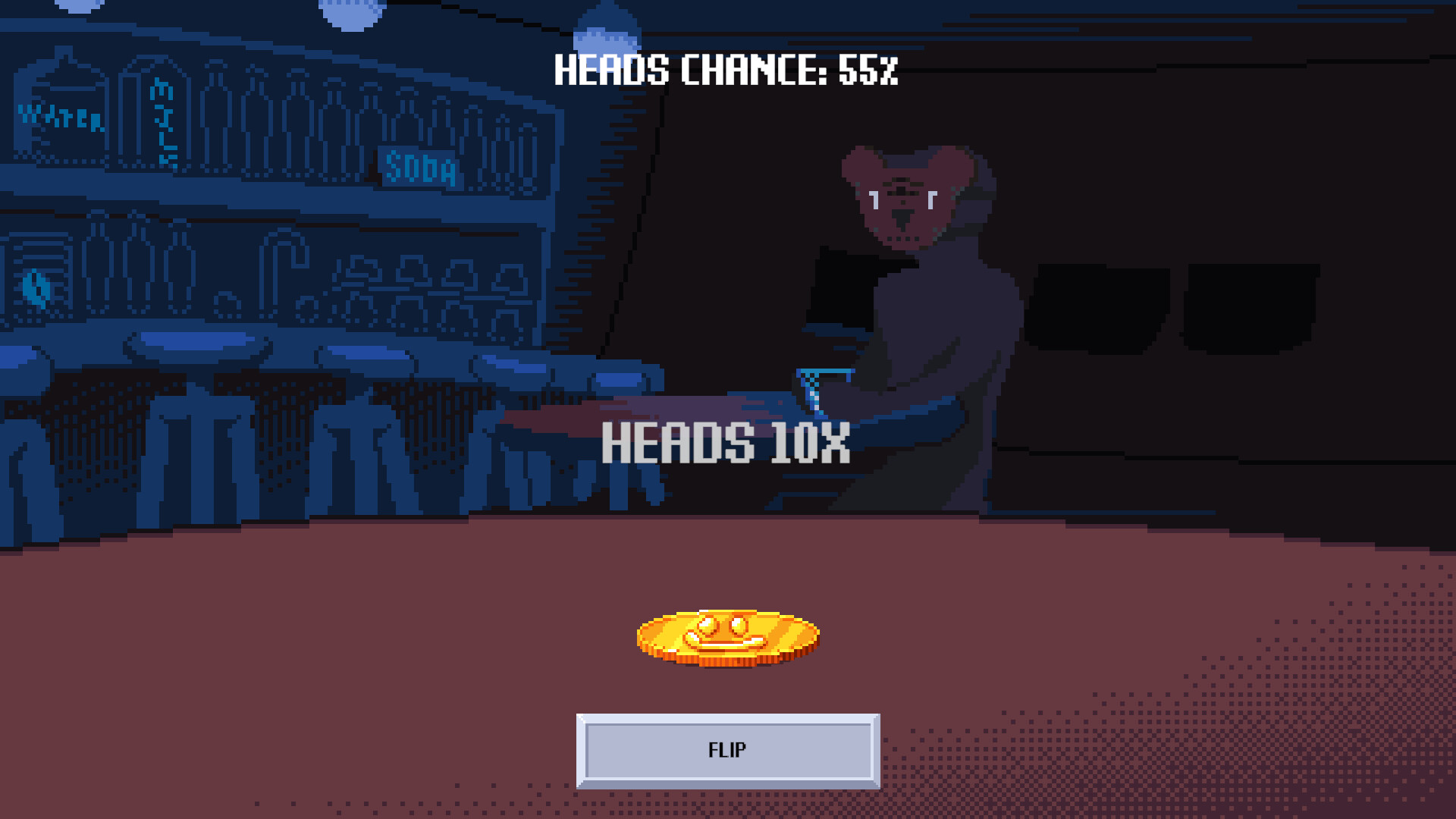 (Image credit Heather Flowers/Steam)
For some reason my brain did not consider the possibility that I could get the same ending twice in a row. By playing it again, my brain reasoned that I must get a different ending than the one I got last time. The thing about probability is the previous result of a chance based thing does not at all effect the current result of a chance based thing. So I played the game a second time, the coin landed on it's side again, and I was flabbergasted. Of course, in retrospect, it was immediately obvious, and I felt stupid for not realizing that beforehand, but I couldn't help it. I know I'm not the only person who's fallen for this because if you browse the reviews of this game, other people have negatively reviewed this game for that very reason. Our brains aren't wired to understand numbers and probability the way computers do, because we developed mathematics and probability in order to try to understand the real world, not the other way around. Flipping a coin in real life is always 100% guaranteed to land the way it lands because of the way you flip it, it is a physical object and it behaves under the laws of physics. But it's functionally impossible for humans to predict that outcome without assistance, and so it feels random, even though it technically isn't.
Computers are also technically not "random" either, they use mathematical formulas to create outcomes that the end user cannot predict but are often not considered to be "true" randomness. If you go to the random number generator on random.org they'll tell you they they offer "true" random numbers because theirs are based off of atmospheric noise. But, I mean, if a digital algorithm isn't "true" random even if the outcome is equally hard to predict, then what makes randomness based off of an analog source random-er than one that isn't? Now, I'm not a computer scientist or a mathematician, but my understanding is that, let's call it Digital Randomness (as opposed to Analog Randomness) is more likely to be weighted or biased, even unintentionally. Take a look at how the randomizer for Tetris on the Game Boy works, I don't fully understand it, but the simple breakdown is that there is not an even distribution to how the pieces are chosen due to how it's programmed. However, I think that this is more or less a solved problem nowadays, which is why I'm making the distinction of Analog vs Digital Randomness because I'd rather "true randomness" mean that the odds are not meaningfully weighted in any way.
The problem is, true randomness often does not feel good to the end user. Think about the Wheel of Fortune card from Balatro, which has a 1 in 4 chance to upgrade your Joker cards and it says "Nope!" when it doesn't work. That's an example of something that uses "true" randomness to feel bad intentionally. Another example you might be familiar with is the story about iPod's shuffle feature: Initially the algorithm was entirely random, but it often lead to tracks from the same artist or same album playing all at once. Users complained, thinking this meant that it wasn't actually random, and so the algorithm was changed to prioritize playing meaningfully different songs. Human perception of randomness is simply not the same as true randomness. If you have ever complained about RNG in video games (or heard other people complaining about it), this is why. We naturally assume that previous results affect the next results when they don't, this phenomenon is known as Gambler's Fallacy. Humans are natural pattern-seekers, we evolved to be that way because it helped us survive in a threatening world. If you see someone slipping in a puddle of mud, you're going to go around it in order to avoid that, and that helps you live a longer life.
But not everything works that way, and we try to extend logical patterns onto things that defy that framework. This is why humans are so naturally superstitious and religious. Thousands of years ago, we had no clue why it rained whenever it rained, so if you sacrificed an animal in order to appease the gods during a drought, and it rained the next day, you'd probably go on the rest of your life believing that that actually worked. In the modern age, we think we understand this better but we do not necessarily. Think about how many people still believe obviously wrong things, like take antivaxxers, for example. They're trying to make sense of a world they don't understand and so they blame illnesses and disorders on vaccines, because it's easier for them to accept that there's a distinct cause and something they can fight against, rather than accept that these things happen and we can't easily predict them.
Unfair Flips reminds us that we are fallible humans, and sometimes we don't understand the universe the way we think we do. It bills itself as "a game about probability", but I think it's really a game about human psychology.
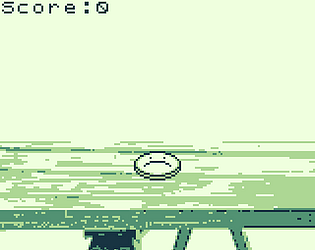
(Unfair Flips GB, a demake I created in GB Studio)
Darn, I feel like that would be a really good note to end this blog post on, but I have something else to talk about: I liked this game so much that I re-created it for Game Boy using GB Studio. It's, as the time of this writing, the first and only video game project I have completed, it took me about 3 non-consecutive days, because it turns out making a coin flipping simulator is really easy, actually. I did dumb it down a little, there's no monologue in between flips, and after a bit of experimentation I cut out the upgrade store entirely, your coin flip chances and combo multiplier now increase automatically when you hit certain score thresholds, and the coin remains the same speed throughout the entire experience. I also changed the endings around a little bit, partly out of laziness, and partly to change the Eggbug reference to a different reference. These changes are all also partly due the fact that I was a bit anxious about making an experience that could replace the original game by Heather Flowers, which is part of why it feels a bit dumbed down in comparison.
Fun fact: Since it runs on Game Boy, it achieves randomness based on the user input when you're going through the opening text, everything is pre-determined after that fact and the rest of the game is just watching it unfold, even if it still feels like you are affecting it by choosing to continue flipping the coin. Makes you wonder if all of life is like that too, huh.
(Like my writing? Leave me a tip on Ko-Fi!)